Sunday, June 5, 2016

Shapeshifting in Sword and Sorcery Games


This post, Shapeshifting in Sword and Sorcery Games, on Hari Ragat Games makes a nice follow up to my previous posts on the Loup Garou. I like the idea of shamanistic shape shifting and it could make a good alternative to infection or to a direct curse. Check it out.

Here's my previous set of All Hollows Even posts related to lycanthropy:

All Hallows Eve #1: The Wild Man


All Hallows Eve #2: Adventure -- The Werewolf of Blackwood


All Hallows Eve #3: Adventure Seed for a Loup Garou


All Hallows Eve #4: Werewolf Legends


All Hallows Eve #5: The Werewolf Bit You -- Now What?


Saturday, June 4, 2016

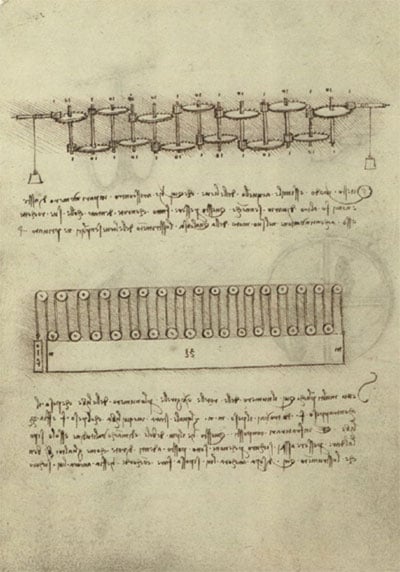
Unusal Item: The Da Vinci Codex

The Da Vinci Codex

"On close inspection of the codex with a mirror they see that it is written in a Italian using mirror writing, so they use a mirror to duplicate the feat. The codex contains plans for Da Vinci's greatest invention, an 'ordinator' or giant mechanical engine designed to calculate and perform all mathematical functions. The inside is planned as a great interlocking series of watch-gears, each representing a small piece of information. The outside bears turning numeral gears and a vast array of buttons and levers."


The first mechanical calculator may have been conceived by Leonardo da Vinci (1452-1519) around 1502. Da Vinci's invention was forgotten for over 300 years. In 1967 scientists working in the National Library of Spain, Madrid stumbled upon two unknown works of Leonardo da Vinci, now know as the "Codex Madrid". One of the works contained notes on a device for calculation. In 1968 IBM hired Doctor Roberto Guatelli, a famous world expert of Leonardo da Vinci, to build a replica.


An early version of today’s complicated calculator, Leonardo’s mechanism maintains a constant ratio  in each of its 13 digit-registering wheels. For each complete revolution of the first handle, the unit wheel is turned slightly to register a new digit ranging from zero to nine. Consistent with the ten to one ratio, the tenth revolution of the first handle causes the unit wheel to complete its first revolution and register zero, which in turn drives the decimal wheel from zero to one. Each additional wheel marking hundreds, thousands, etc., operates on the same ratio. Slight refinements were made on Leonardo’s original sketch to give the viewer a clearer picture of how each of the 13 wheels can be independently operated and yet maintain the ten to one ratio. Leonardo’s sketch shows weights to demonstrate the equability of the machine."

The "lost" Madrid Codex is a McGuffin in the Flashing Blades Adventure: The Man in the Mask. The PCs are sent to obtain the notebook, which contains plans for the calculator, called an "ordinator." I particularly liked Mark Pettigrew's use of a real document for his adventure plot. After reading up a on the Madrid Codex I found Pettigrew's suggested resolution of the scenario wherein the Codex is  tossed in a bonfire a clever "explanation" for the document's real world disappearance. Of course since we now know that the codex was either not destroyed or that there was a copy that ended up in Spain, the apparent destruction, may have been a ruse.

Da Vinci wrote his notebooks in a sort of code using mirror writing. He wrote everything in mirror image (probably by using a mirror). This provided a nice puzzle for the Savvy PC to solve.


"On close inspection of the codex with a mirror they see that it is written in a Italian using mirror writing, so they use a mirror to duplicate the feat. The codex contains plans for Da Vinci's greatest invention, an 'ordinator' or giant mechanical engine designed to calculate and perform all mathematical functions. The inside is planned as a great interlocking series of watch-gears, each representing a small piece of information. The outside bears turning numeral gears and a vast array of buttons and levers."

And there are many other amazing products of Da Vinci's genius to serve as McGuffins for additional adventures.

In Popular Culture
  • The plot of the clockpunk 2011 version of the movie The Three Musketeers uses Da Vinci's notebooks, and several of the inventions therein, as the McGuffin that sets the plot rollling. Someone who wants a gonzo clockpunk should watch this film.
  • The Starz TV series Da Vinci's Demons uses working and often fantastical versions of many of Da Vinci's inventions. The series is a great source for gonzo plots and devices.

Friday, June 3, 2016

It ain't pretty...

...but it's usable.


I was going to do a post on Da Vinci's plans for a calculator, but that will have to wait. In my current campaign (May/June 1624) the players have been investigating the handcarts pushed by some raggedy men that transported some huge rats from the sewers to the granaries around Paris. Their search led them to the basement of Bon Robert's tavern - a seedy little spot north of Les Halles market. I find describing rooms for players to map over Skype is more difficult than I recall it being long ago when we did cave and dungeon exploration in D&D and Runequest. So periodically I give the players a version of what they have explored. Since they may revisit the sewers this weekend, I wanted to post a players version map for their use. So here it is.

It looks a little odd because I snipped bits from my GM's map and left out the areas e.g. behind the iron door, that have not been investigated. The 3D image of the block is from the 1615 Merian map of Paris.

EDIT: Let's try uploading the picture directly.


Download Map

Thursday, June 2, 2016

Introduction of a new PC

In the D&D campaigns of my youth many players and parties made up of the PCs of those players who were available that session were the norm. Gradually my style of play shifted to a smaller group of players who played regularly. This tended to promote two different styles of campaign. The single group of PCs who were closely linked and a troupe style of play where each player had multiple PCs and they selected the PC or PCs who were most fitting for the anticipated activity. 

One expectation of the D&D campaigns was that little rationale was necessary for why a new PC was accompanying the party. Everyone knew that, from an out of game perspective, Dave's PC was there because Dave was there and he needed to play some character to have any fun that night. As the PCs became part of an established group or troupe of associated characters - like the crew of a starship - more explanation was needed in game to justify why Dave's PC was joining an established group. Which is a long introduction to an example of the justification I used to introduce a new PC, Father Signoret, to my Honor+Intrigue campaign. Note that Father Signoret's cousin, Guy de Bourges is one of the campaign's original PCs.


Ad maiorem Dei gloriam!


By the flickering candlelight, the dark clad figure moved precisely over the geometric symbols chalked out on the old basement floor. If not for the sword held lightly in one hand, one might have thought the figure was practicing some new style of ballet. But the dancelike circular movements were part of La Verdadera Destreza – the True Art or as some called it, the Spanish style – whose precepts are based on reason, geometry, and the writings of classical authors such as Aristotle, Euclid, and Plato. A style perfectly suited to a Jesuit-trained scholar of the classics. At least so Father Gaétan Signoret said to those within his order who criticized his fascination with the True Art. But even this momentary break from the focused concentration required to perfectly perform the precise movements, caused an awareness of other sensations that came in a sudden rush: the trickle of sweat down his chest and back despite the cold of the basement, the heaviness in his arms and legs from long exercise, the smell of burning animal fat in the cheap tallow candles that were all he allowed himself for his exercises, and the sound of his deep, but even breathing…Not just my breathing, someone else is in the room with me. He turned quickly, but fluidly, letting blade lead arm, body, legs, and feet. He was not alone. Down the three foot length of steel he saw the startled gaze of his mentor and friend, Denis Petau or Dionysius Petavius, the Latinization of his name that he preferred for teaching and for scholarly debate. Dionysius Petavius was one of the most brilliant scholars in a learned age and a member of the Societas Iesu, the Jesuit Order. 


“Gaétan, Gaétan, always this fascination with the sword. I had hoped to find you reading the works of the ancients or the Scriptural Exercises.” Gaétan smiled somewhat sheepishly. “Well you must set your sword aside for now. The Provincial Father wants to see you. In his office. Now.” Petavius had taught Gaétan theology when he first began his studies back in Bourges. It was Petavius that opened his eyes to the cut and thrust of intellectual debate. If not for his mentor, Gaétan would never have become a Jesuit. Like most of his social class, he would have remained a practically unlettered aficionado of the hunt or the sword. Not that Gaétan didn’t enjoy the hunt or the sword, but those physical activities did not circumscribe a world view which had grown to include Church theology and history as well as the brilliance of ancient thinkers such as Plato, Aristotle, and Euclid and which was enforced with the rigid discipline and self-abnegation central to the life of a Jesuit.


“Of course,” he said as he bowed his head in acknowledgement, then he gestured with his rapier. “I suppose I had better leave this until after I have seen the Provincial Father. What is it he wants?”


“The Provincial Father did not see fit to explain his reasons to me, Gaétan. Nor did he expect you would need a reason beyond his summons.”


“Of course Father. I was only curious.”


“Curiosity is a good thing in a scholar, Gaétan. But our curiosity must always be tempered by our obedience.” 


When Gaétan entered the office of the Provincial Father, the first face that he saw was that of Louis Cellot. The Provincial Father was an intelligent, kindly looking man He was a respected scholar of the humanities, a theological writer of some note, a dramatist and poet, and possibly the most powerful member of the Order after Muzio Vitelleschi the Superior General of the Society of Jesus back in Rome itself. Gaétan was surprised to see that the Provincial Father was not alone. There were three other men in the room all of them dressed in clerical garb. One was a man of about forty years of age with the look of a scholar. He spoke French fluently but with a slight accent, possibly German. He introduced the younger man sitting next to him as Jan-Karel. The other was perhaps fifteen years younger. Since he was only in his mid-twenties it was likely that he had not yet taken his final vows. Most members are not as precocious as I am. Jan-Karel spoke with a most pronounced accent, but not one that Gaétan could place. The third man was the most mystifying. He wore a monk’s brown robe but his face was concealed by a black cloth mask. Of the three, he was the only one that the Provincial Father introduced, calling him Père Noir. Gaétan smiled to himself as he thought, No doubt Petavius would say I’m leaping to conclusions, but I suspect that the masked one’s true name is not Father Black. The really odd thing is it seems like even the Provincial Father is deferring to this Père Noir.
 

Initially the man known as Jan-Karel did most of the talking and his conversation was all about one thing, something he called the DaVinci Codex. It was some minutes before Gaétan figured out Jan-Karel meant some sort of book. He certainly talks a lot without really coming near to any sort of point one can actually understand. Apparently the author of this book was someone named DaVinci – Wasn’t he a painter or sculptor or something? And the book itself was thought to pose some great danger. According to Jan-Karel, the book contained the plans for some sort of machine. Maybe a war machine? Neither Jan-Karel nor the older scholar really explained what the machine was for nor what was so dangerous about an old book or the machine it described. I wonder if this would make more sense if they both spoke in Latin?

Perhaps Père Noir sensed that Gaétan was finding the conversation confusing. In any event, he interrupted somewhat abruptly, “Thank you both. Father Signoret is not an engineer nor a geometer, so I think that is enough of the scholarly details for now. I will tell you what you need to know. This book contains a kind of knowledge that the world has not seen for many ages. And like the fruit of the tree of knowledge as described in Genesis, this is knowledge that man is not meant to have. Therefore, we must prevent Adam from eating of this fruit lest all chance of salvation be lost. This knowledge cannot be released into the world and most especially, it cannot be allowed to fall into the hands of the Dutch, English, and German heretics nor of the infidel Turks. Your mission, Father is to ensure that it does not, by bringing the Codex to the Order. As God’s True Soldiers only we can be trusted to keep this knowledge from the wrong hands.” Gaétan noticed that Père Noir spoke quietly and without a trace of accent, but his voice vibrated with passion and intensity. This Père Noir is a very determined man.


“Father Gaétan Signoret, you are directed to find out the current location of the Codex. Do not risk it falling into the wrong hands by being too ambitious or too foolhardy. Better to communicate its location and let us handle its recovery. However, should a safe and certain opportunity present itself, then you will act for the Glory of God. The Codex was last known to be in the possession of your cousin, Guy de Bourges. Father Signoret, do not fail the Order. You act for the Greater Glory of God. Your orders come directly from your own Provincial Father, is that not correct, Provincial Father?”


Louis Cellot, spoke, “Yes. That is correct. Father Signoret, you are ordered to act as Père Noir has directed. Ad maiorem Dei gloriam!”


After evening prayers, Father Signoret pondered this new mission. My cousin is too clever to be easily deceived. I need a plausible reason to spend time with him so that I may observe him and his friends and from that learn something of the whereabouts of this Codex. The Jesuit order allows us to go about the world, perhaps I can suggest an expansion of that rule. Yes. I think that may do the trick.


Therefore on Sunday, Signoret arranged to be at the church in Paris where his cousin Guy usually went to hear the Mass. Afterwards, he told his cousin of his new “vocation” to engage with the world of adventure and practice his skills “for the greater glory of God.” Then he asked Guy’s help in this mission and to introduce him to any adventurous friends that Guy may have.


“I may know one or two.” Guys said with a faint smile. Guy suggested that the two cousins should meet at the Les Deux Chevaux tavern that Thursday night so that Guy could introduce his cousin to his friends.

Wednesday, June 1, 2016

Period Artwork

While searching for something else on the net I came across a blog devoted to toys and miniatures, including bas relief tin flats. Among the posts related to Renaissance and Early Modern minis, there was a post from 2012 that mentioned a great site for period engravings: The Frederik Muller Historieplaten digital collection from the Dutch Rijksmuseum.Due in part to having the highest standard of living in the world, the Netherlands in the Early Modern period is a great source of period paintings and engravings. 

City plans like this one for the town of 's-Hertogenbosch are perfect for historical city maps for GM and player. Some skill with GIMP, Photoshop, or even Paint can allow the GM to highlight or mark specific areas.

's-Hertogenbosch besieged by Prince Maurice, 1601


Admiral Tromp's flagship Aemilia, ca. 1639


This picture is inspiring for a parade or victory celebration. When the resolution is high enough, as it is with these engravings, these can be a good source of faces for various NPCs. I particularly like the inn sign on the right and the odd wagon-coach in the center is interesting.


Arrival of five Spanish ambassadors, at Rijswijk, February 1608

Detail of odd wagon-coach 

Tuesday, May 31, 2016

What I'm Reading: A History of France by George William Kitchen


Currently I am reading from a history of France.

While doing some research for my campaign timeline, I came across a multivolume history of France. I’m using two of the volumes to add to my knowledge of the period and to my campaign timeline.


One might ask why I am using a source that is over one hundred years old. Well there are two reasons.

First, these books are written at a level of detail that is quite useful for my purposes. For example, one footnote 2 on page 24 quotes a satiric writing of the time that lists clerical supporters and allies of Richelieu.

This information is perfect for my campaign. Several PCs work for Richelieu as guards or as one of his secretaries and the secretary is a Jesuit who is there to spy on Richelieu. So knowing who some of his chief clerical supporters were, and by process of elimination, who were not supporters, is extremely useful in sorting through the rivalries between the various Catholic groups e.g. Capuchins, Jesuits, Dominicans, Oratorians, Richelieu himself, etc.Henri d'Escoubleua de Sourdis Bishop of Maillezais (and later Archbishop of Bordeaux) is now a new NPC allied to Richelieu. And thus a new source for intrigue and a possible patron. Perhaps Father Signoret may be promoted to a position on the Curia of Bishop de Sourdis.

The second reason is that the EBook is free and available. So the price is pretty difficult to beat.

EDIT: Let's see if this fixes the image links. 

Sunday, May 22, 2016

Campaign Calendar

One of the things I've done for several campaigns is to keep a campaign calendar. I first started doing that around 1980 when I started my first Runequest campaign set in Balazar and the Elder Wilds of Glorantha. A lot of that campaign was wilderness exploration, literally in the case of the Elder Wilds, and weather and seasons were a big factor in travel. In addition the detailed information on cults in Glorantha made it important to know whether or not a day was the Holy Day for some cult. 

Later in the 1990s when I started my Star Wars campaign, I had multiple player groups and a co-GM so tracking time had the potential to be important to keep track of who was where and when. I wanted the player characters to have time to grow in knowledge and competence before the movies. At that time, there were only the original three films so I set the start of the campaign to 3 years before the Battle of Yavin (3BBY). The timeline started in the mists of the Old Republic 25,000 years before declaration by Senator Palpatine of the New Order and Empire. The ancient history provided by West End Games and the extended universe was useful for a few relic hunting adventures and to know how long some of the alien and human cultures had interacted. But for the most part, the history closer to the time of Episode IV: A New Hope was important. I included things like the Clone Wars, Foundation of Empire, and the year or even date of birth for PCs and for relevant NPCs. I needed to know how old an Old Republican Senator might be and it was kind of satisfying to know how old characters were or even to be able to celebrate a birthday. As the prequels came out, I fit those dates into my chronology. I used one of the calendars from the extended universe that had ten months of 35 days with a few intercalary days. The intercalary days nicely fit my image of Palpatine and the Empire, mirroring in some ways, the Claudian dynasty and the start the Roman Empire. And the intercalary days provided some holidays, which occasionally provided a plot hook and helped ground the players and characters in the setting. Using the calendar I was able to fit in activity for the PCs that linked to and supported A New Hope. PCs were responsible for the creation of one of the Rebel Alliances major medals, the Wings of Freedom, awarded for saving the life of Mon Monthma, spiriting away from Incom the plans, prototypes, and core design team for the X-Wing, a couple of key steps in the acquisition of the Death Star plan, the rebellion of an entire sectors, and other stuff along the way. The campaign ran for over 10 years of real time and 3 years of game time (some PCs lead very hectic lives) and finally went on hiatus at the end of 2011 or about six months after the end of A New Hope. 

That is all a long introduction for the fact that when I decided to run Honor+Intrigue and set it in an historical fiction version of 1620s France, I knew I would need a calendar so I could track what was going on in the wider game world based on our real world history. I wanted to involve the PCs with real life people and events - as well as with fictional characters. The King's Musketeer PC practices fencing with Athos and several PCs are in the Cardinal's Guards. One is the Guard's first Captain-Lieutenant.  

The timeline is a bit long. It runs to an 18 page table. I've grabbed historical events from a lot of sources to create the campaign timeline and then fitted in the adventures of the PCs when they occurred. To keep it from being ridiculously long, I've kept the entries for the adventures to just the Book, Adventure # and name, and Chapter # and name. I have a separate file that lists the experience (Advancement Point) awards and expenditures of the PCs and third file in Excel so I can run stats to see how fast I award APs and at what rate different PCs gain awards.

As the timeline might be useful as a resource, I decided to place the timeline as a page on my blog. I'll update the page  periodically.