My first thought on seeing “A Glorious Poison: The Deadly Toxins of Palace Life” was the Affair of the Poisons, but Eleanor Herman's post is just as interesting and covers matters far more often seen at court and elsewhere during the 17th century. Here book is out and it too covers more than just murder. Check it out.
Her new book is The Royal Art of Poison: Filthy Palaces, Fatal Cosmetics, Deadly Medications, and Murder Most Foul (St. Martin’s Press, June 2018.

Showing posts with label Culture. Show all posts
Showing posts with label Culture. Show all posts
Wednesday, June 20, 2018

Wednesday, March 29, 2017
Magical Investigations by Martin del Rio

I've introduced witchcraft into my campaign. This has caused the scholarly PCs to consult experts and to want to do some research of their own about witchcraft. One of the aspects of Call of Cthulhu that I like is the occult tomes. So I wanted to replicate a bit of that. I'm also aware that the period in which my campaign is set saw the publication of more than a few books about magic and witchcraft and I wanted to include some of the real books in response to these requests by the players. In a previous post I highlighted Discours des Sorceirs. In this post I highlight Magical Investigations.
Magical Investigations
(Latin: Disquisitiones Magicae) by the
Jesuit Martin del Rio, a six book work on magic, superstition, and witchcraft
which first appeared in three volumes published in Leuven in 1599 and 1600 by Gerard Rivius.
In 1624 version in six volumes was published under the name Disquisitionum
Magicarum Libri Sex. The work
contains many ideas of the Malleus Maleficarum ("Hammer of the Female
Witches", 1486) as well as de Rio’s experience as a young magistrate and
colleague of Nicolas Remy, the famous magistrate and hunter of witches. Delrio
also drew on histories of other countries and continents, as well as Jesuit
reports from the New World. Delrio also drew on histories of other countries
and continents, as well as Jesuit reports from the New World. The work
associates witchcraft with both heresy and the Devil. A French translation was
published in 1611. Among other things the text explains that Witches can render
themselves invisible with the help of the Devil.
The French National Library hosts an online version of Disquisitiones Magicae.
Here are a couple of previous postings for books on witchcraft: Discours des Sorceirs and the Malleus Mallificarum. And for the book collectors, here's a posting on the cost of books in the period.
Thursday, March 23, 2017
Jousting on the Seine
While I was looking for pictures of the Tour du Bois I came across this illustration by Jacques Callot. It does depict the Tour du Bois. No it's not the lonely looking tower just left of the center of the picture. That's the Tour de Nesle and its on the Left Bank. The Tour du Bois is hard to see, but it is over on the Right Bank. It too is towards the center of the picture but it is much smaller. More about the Tour du Bois later. Also on the right side of the engraving is the Louvre both what was left of the medieval castle at the right edge of the image and running past it (up and to the left in the engraving) is the Louvre Gallery.

The above engraving by Callot is called "Annual jousting contest on river Seine in Paris" by Jacques Callot in 1630. So here's something I didn't know. They joust on the River Seine in Paris. I had to look at that twice, so I'll repeat that.
They joust on the River Seine in Paris!
How frickin' cool is that? I must know more and I must stick some characters in boats in a chase scene in the middle of the annual joust. It's like some crazy 1630 version of the big budget, special effects chase scene in every single James Bond movie ever! Like I said, how frickin' cool is that?
For the more academically or pedantically inclined I will now continue identifying the Tour du Bois. Here's a detail view from the center area of the engraving with the Tour du Bois circled in yellow.

It's easier to see the Tour du Bois in this illustration by Silvestre. The Tour de Nesle is on the left and the Tour du Bois is on the right. That's the Gallery of the Louvre behind the Tour du Bois.
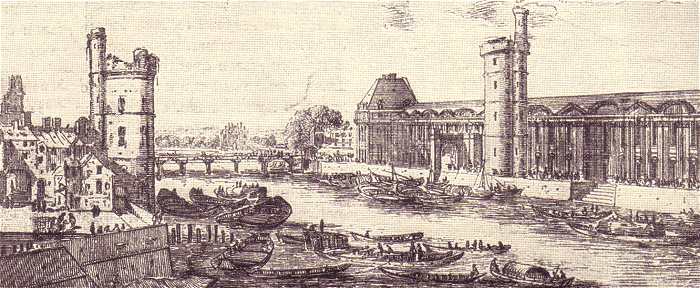
There used to be another tower called the Tour du Coin. The Tour du Coin and the Tour de Nesle were on opposite sides of the Seine and back around the time of Joan of Arc they had a big chain they could stretch between the two towers to stop boats from passing.
Now back to the jousting. Here's a painting from 1756 called La joute de mariniers entre le pont Notre-Dame et le Pont-au-Change, by Nicolas-Jean-Baptiste Raguenet. So those boatmen were not just jousting west of the Pont Neuf they seem to be jousting all along the Seine in Paris.

Another thing to notice are all the houses and shops built on top of the bridge. Talk about your crowded real estate market. Eventually the Parisians tore the buildings down. They were a fire hazard. Now I know what you are thinking. You're thinking, Gaston, what about the jousting?
OK. OK. Here's an advertising poster from before World War I which was sometimes called the Great War. But really for the guys in the trenches or the men and women in the field hospitals it really wasn't so great.

Below are several photographs that show guys actually jousting. So you can see how it works. Here's what winning (and losing) looks like.

In this photo I can't tell who is winning and who is losing.

It looks like these guys are using a seat cushion for a shield. You can see the shield clearly in this photo.
I bet I could work this into a Call of Cthulhu scenario too. Watching the boat jousting seems perfect for your visiting dilettante characters from England or for an American tourist wanting to experience some of the quaint customs of the old country. Happening to be in the audience also seems like just the thing to connect a bunch of otherwise unconnected characters.
There are a bunch more boat jousting photos here.
Thursday, March 16, 2017
Merry Company

Dirck Hals, Merry Company at Table, 1627–29
Merry company
is the term in art history
for a painting, usually from the 17th century, showing a small group of
people enjoying themselves, usually seated with drinks, and often
music-making. These scenes are a very common type of genre painting of
the Dutch Golden Age and Flemish Baroque; it is estimated that nearly
two thirds of Dutch genre scenes show people drinking.
The term is the usual translation of the Dutch geselschapje, or vrolijk gezelschap,
and is capitalized when used as a title for a work, and sometimes as a
term for the type. The scenes may be set in the home, a garden, or a
tavern, and the gatherings range from decorous groups in wealthy
interiors to groups of drunk men with prostitutes. Gatherings that are
relatively decorous and expensively dressed, with similar numbers of men
and women, often standing, may be called Elegant Company or Gallant Company, while those showing people who are clearly peasants
are more likely to use that word in their title. Such subjects in
painting are most common in Dutch art between about 1620 and 1670.
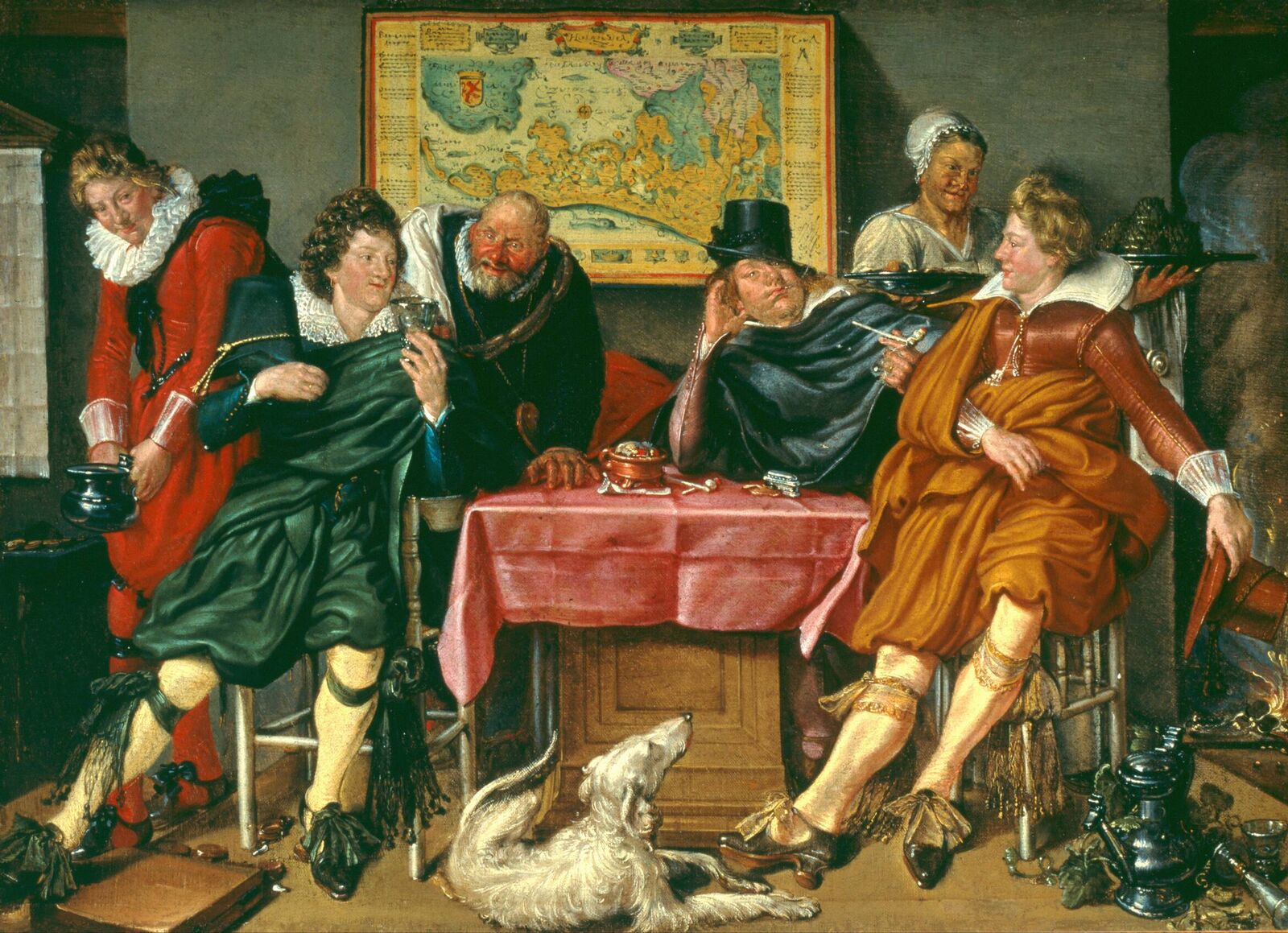
Willem Pietersz. Buytewech, Merry Company, c. 1620, apart from the maid an all male group


Abraham van den Hecken, A Merry Company in a Tavern, 1640s

Jacob Ochtervelt, Musical Company in an Interior, c. 1670


Jacob Duck, 1635-40

Jan van Hemessen, The Prodigal Son, 1536
_(alta_resoluci%C3%B3n).jpg)
Peter Paul Rubens, Garden of Love, 1630–35, the apotheosis of the outdoor courtly company
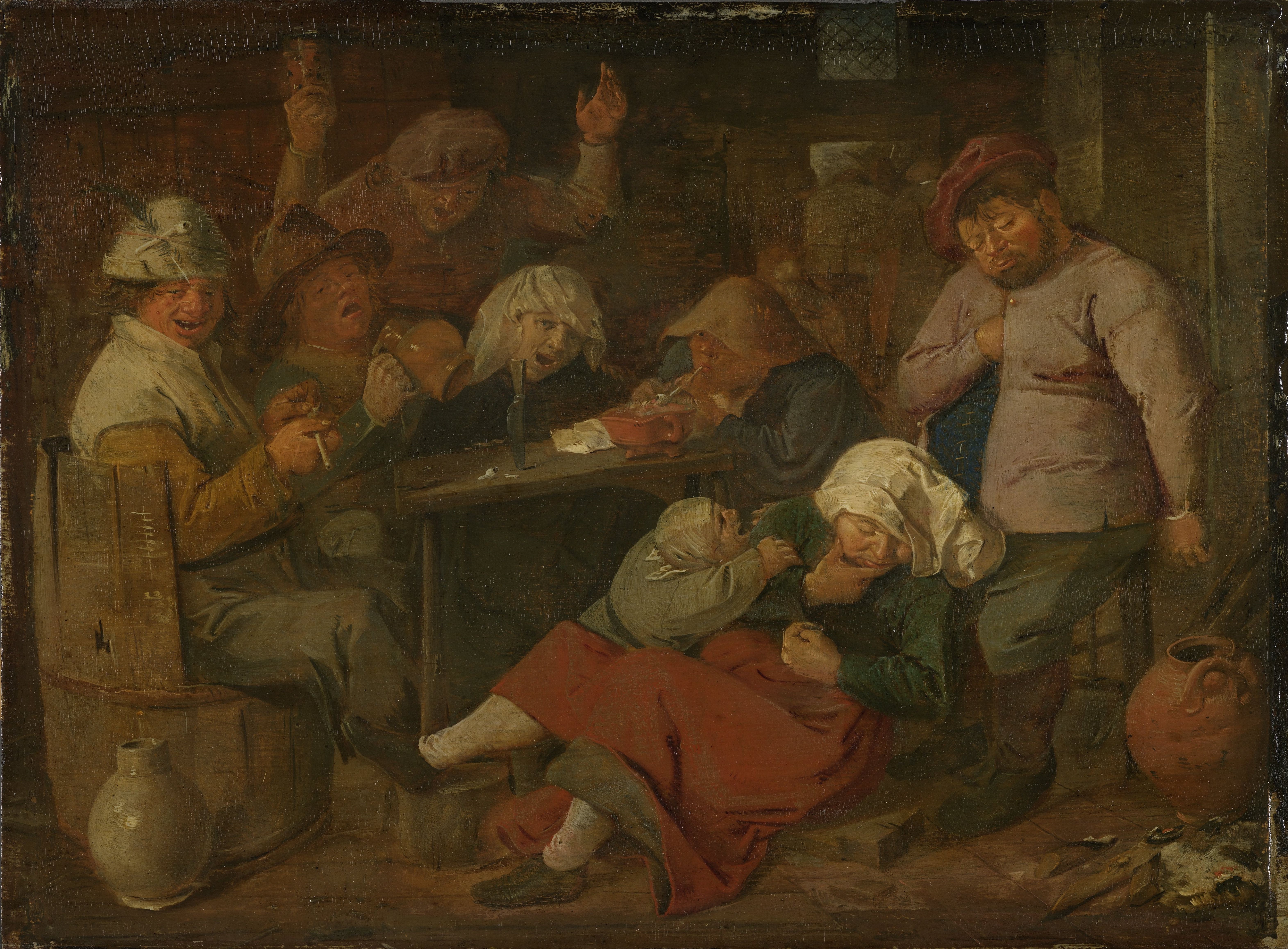
Adriaen Brouwer, Inn with Drunken Peasants, 1620s
Tuesday, March 14, 2017
Two card games and a dice game: basset, lansquenet, and passe-dix

16th Century German Playing Cards
I like to include period games in my setting. In The Three Musketeers Dumas mentions Porthos as playing three games: basset, passe-dix, and lansquenet. To come as a cousin and take his place every day at a good table, to smooth out the wrinkles on the old solicitor's creased and yellow brow, to pluck the young clerks a little by teaching them “basset,” “passe-dix,” and “lansquenet,” in their finest points, and by winning from theme, by way of fee, for the lesson he would give them in an hour, their savings of a month,—all this was an enormously delightful outlook for Porthos.
basset, passe-dix, and lansquenet: Basset and lansquenet are card games. The latter, from the German word landsknecht, a mercenary foot soldier, came to France only at the end of the seventeenth century. Passe-dix is a dice game.
From the notes for The Three Musketeers: (Penguin ClassicsDeluxe Edition) by Alexandre Dumas.
Taking a look at these three games one notices several things. First, Dumas didn't worry too much about minor anachronisms in his writing. Thus Porthos plays basset in the mid 1620s despite it not being introduced to France until 1674. Second, since Porthos presumably was the banker when teaching the clerks basset, Porthos is happy to take away the poor clerks' monthly savings in what is a more or less rigged game. Again we see that Dumas clearly shows his "heroes" to be rogues not paladins.
Basset
Basset (French bassette, from the Italian bassetta), also known as barbacole and hocca, is a gambling card game
that was considered one of the most polite. It was intended for persons
of the highest rank because of the great losses or gains that might be
accrued by players. According to the (Dizionario etimologico della lingua italiana, the word Basetta is first recorded in the first half of the 15th century. The game Basset is described by a few authors as having been invented in 1593 by a noble Venetian named Pietro Cellini. Basset is played by Porthos in the Alexandre Dumas novel The Three Musketeers.
Basset
was first introduced into France by Signior Justiniani, ambassador of
Venice, in 1674. The game was very popular at the court of King Charles II, and even after 15 January 1691 when Louis XIV
issued an order from the privy council, by which he expressly forbade
not only the officers belonging to his array, but likewise all other
persons of whatever sex or denomination to play at Hoca, Pharaoh,
Barbacole and Basset. The sums of money lost in France at this game were so considerable that the nobility
were in danger of being undone after many persons of distinction were
ruined.
In Basset, large advantages were secured to the
tailleur (the dealer / keeper of the bank) and so vast were their gains,
that the privilege of keeping a bank at Basset, where the stakes were
unlimited, was granted only to cadets or other members of great
families. It was basically certain that a considerable fortune could be
realised by the tailleur in a short time. The advantages of the dealer
arise in many ways, but mainly from the temptations for adventurous
players to increase their stakes on certain desperate chances, which
rarely turn up, and which in the long run told largely in favour of the
bank. Where licenses were otherwise conceded for keeping a public Basset
table in France, the stakes were strictly limited to twelve pence.
The play in Basset resulted in, basically, a lottery.
A player might occasionally win, but the big winner was the dealer
(banker). The dealer had a number of privileges under the rules,
including having the sole disposal of the first and last card; this gave
him or her a significant edge. This was a truth so acknowledged in
France that the king ordered, by public edict, that the privilege of a tallière (banker) should be allowed only to the chief cadets (sons of noblemen). His assumption was that whoever kept the bank must, in a very short time, acquire a considerable fortune.
Game play
The
players sat round a table, the talliere (banker/dealer) in the midst of
them, with the bank of gold before him, and the players each
having a book of 13 cards. Each laid down one, two, three, or more, as
they pleased, with money upon them, as stakes. The talliere took the
remaining pack in his hand and turned them up, with the bottom card
appearing being called the fasse; he then paid half the value of the
stakes laid down by the players upon any card of that rank.
After the fasse was turned up, and the talliere and croupiere (bet
collector, similar to a stickman) had looked round the cards on the
table, and taken advantage of the money laid on them, the former
proceeded with his deal; and the next card appearing, whether the king,
queen, ace, or whatever it might be, won for the player (1-1 payout),
the latter might receive it, or making paroli (parlay their bet), as
before said, go on to sept-et-le-va (7-1 payout). The card after that
won for the talliere, who took money from each player's card of that
sort, and brought it into his bank, an obvious and prodigious advantage
over the players.
The talliere, if the winning card was a king, and the next after it
was a ten, said (showing the cards all round): 'King wins, ten loses,'
paying the money to such cards and taking the money from those who lost,
adding it to his bank. This done, he went on with the deal: 'Ace wins,
five loses; 'Knave (Jack) wins, seven loses;' and so on, every other
card alternately winning and losing, till all the pack was dealt but the
last card. According to the rules of the game, the last card turned up
was for the advantage of the talliere; although a player might have one
of the same sort, still it was allowed to him as one of the dues of his
office, he paid nothing on it.
The bold player who was lucky and adventurous, and could push on his
couch with a considerable stake to sept-et-le-va (7-1 payout),
quinze-et-le-va (15-1 payout), trente-et-le-va (30-1 payout), etc., must
in a wonderful manner have multiplied his couch, or first stake; but
this was seldom done; and the loss of the players, by the very nature of
the game, invariably exceeded that of the bank; in fact, this game was
altogether in favour of the bank; and yet it is evident that, in spite
of this obvious conviction, the game must have been one of the most
tempting and fascinating that was ever invented.
Lasquenet
Lansquenet (derived from the French spelling of German Landsknecht ('servant of the land or country'), applied to a mercenary soldier) is a card game.
Lansquenet also refers to 15th- and 16th-century German foot soldiers;
the lansquenet drum is a type of field drum used by these soldiers.
Lansquenet is played by Porthos in the Alexandre Dumas novel The Three Musketeers and by D'Artagnan in Twenty Years After.Game play
The
dealer or banker stakes a certain sum, and this must be met by the
nearest to the dealer first, and so on. When the stake is met, the
dealer turns up one card and lays it to his right, for the table or the
players, and another card in front of himself for the bank. He then
keeps on turning up cards (while keeping the first two cards visible),
until a card turns up with a value matching either of the first two
cards. For instance, if the five of diamonds has been laid down for the
bank, then any other five, regardless of suit, constitutes a win for the
banker. If the table's card is mached first, he loses, and the next
player on the left becomes banker and proceeds in the same way.
When the dealer's card turns up, he may take the stake and pass the
bank; or he may allow the stake to remain, whereupon it becomes doubled
if met. He can continue thus as long as the cards turn up in his favour –
having the option at any moment of giving up the bank and retiring for
that time. If he does that, the player to whom he passes the bank has
the option of continuing it at the same amount at which it was left. The
pool may be made up by contributions of all the players in certain
proportions. The terms used respecting the standing of the stake are
"I'll see" (à moi le tout) and Je tiens. When jumelle (twins), or the turning up of similar cards on both sides, occurs, then the dealer takes half the stake.
And for those PCs with the Gambler career, Robert-Houdin explained a mechanism by which a card sharp could cheat at lansquenet, by palming and then placing atop the deck a packet of cards in prepared order.
Passe-dix
Passe-dix, also called passage in English, is a game of chance using dice. It was described by Charles Cotton in The Compleat Gamester (1674) thus:
"Passage is a Game at dice to be played at but by two, and it is performed with three Dice. The Caster throws continually until he hath thrown Dubblets under ten, and then he is out and loseth; or Dubblets above ten, and then he passeth and wins."
Andrew Steinmetz, in The Gaming Table: Its Votaries and Victims,
described it at greater length but somewhat confusingly (the results of
rolling a 10 are unclear, depending on whether it wins for the bank or
is a push, there is house advantage is at best 0, and at worst negative,
and the suggestion that it was played at the crucifixion is of course
sheer speculation):
"Passe-dix is one of the, possibly the, most ancient of all games of chance, is said to have actually been made use of by the executioners at the crucifixion of our Saviour, when they parted his garments, casting lots, Matt. xxvii. 35.
"It is played with three dice. There is always a banker, and the
number of players is unlimited. Each gamester holds the box by turns,
and the other players follow his chance; every time he throws a point under ten he, as well as the other players, loses the entire stakes, which go to the banker. Every time he throws a point above ten (or passes ten
-- whence the name of the game), the banker must double the player's
stakes and the stakes of all those who have risked their money on the
same chance. When the game is played by many together, each gamester is
banker in his turn."
Also see the Compleat Gamester.
Thursday, March 9, 2017
As I was preparing my post on wheellocks I came across this post on Dariusz caballeros featuring a fancy wheellock hunting rifle from 1610. I thought it made a nice follow up to yesterday's post on the wheellock mechanism.
The gun features some very pretty engraving.
The gunlock plate is adorned with a
fight scene showing Polish winged hussar cavalry armed with lances
and bows pursuing pistol-armed Western style reiter cavalrymen.


This gun was made by one of the master craftsmen from the Silesian town of
Cieszyn/Teschen, famous since the Middle Ages for their intricately made
gun, rifles, pistols and combined weapons. It was one of two guns made for the Polish monarch Sigismund III circa
AD 1610.
Something like this is perfect for ostentatious PCs. It's a gun...no it's treasure...no it's a gun....
Monday, March 6, 2017
What I'm Reading - The Swerve: How the World Became Modern

The Swerve: How the World Became Modern
by Stephen Greenblatt
The Swerve is focused on how the Renaissance came about and in particular the influence of one book that was rediscovered by a Renaissance Italian book collector. De rerum natura (On the Nature of Things) is a first-century BC didactic
poem by the Roman poet and philosopher Titus Lucretius Carus. On the Nature of Things is Lucretius attempt to explain Epicurean philosophy to a Roman audience.
The title and the subtitle of
the book are explained in the author's preface. "The Swerve" refers
to a key conception in the ancient atomistic theories according to which atoms
moving through the void are subject to clinamen: while falling straight through
the void, they are sometimes subject to a slight, unpredictable swerve. This swerve explains how it is that atoms collide and sometimes combine into new forms (rather than remaining as separate particles). The swerve is also used to explain or justify the existence of man's free will and to reconcile with a materialistic, deterministic philosophy.
I was already that several Greek philosophical schools embraced atomism - essentially the view that
the world was composed of tiny particles. I don't recall the explanation for free will, but I also didn't find it especially convincing, but then neither are any of the other explanations or justifications I have seen. But I was unaware of just how
much of what we consider novel, like a theory of evolution, was really a rediscovery or
reimagining of very old ideas.
It makes me wonder much sooner we might have had a fully realized scientific method and all that entails had works like De rerum not been lost for so long?
This subject is a bit before the period of interest for my blog, but ...
Of particular interest from an RPG perspective is the character of a book finder like Poggio Bracciolini. he is highly educated, has experience and connections in the highest levels of society (he was the private secretary to the Pope), now he is a masterless man, he travels widely, independently does the finding and acquisition of rare books, and he in effect works on speculation or commission. Just like a member of your typical party of player characters.
And all would have asked the obvious question: whom does this man serve?Poggio himself might have been hard-pressed for an answer. He had until recently served the pope, as he had served a succession of earlier Roman pontiffs. His occupation was a scriptor, that is, a skilled writer of official documents in the papal bureaucracy, and, through adroitness and cunning, he had risen to the coveted position of apostolic secretary. He was on hand then to write down the pope’s words, record his sovereign decisions, craft in elegant Latin his extensive international correspondence. In a formal court setting, in which physical proximity to the absolute ruler was a key asset, Poggio was a man of importance. He listened when the pope whispered something in his ear; he whispered something back; he knew the meaning of the pope’s smiles and frowns. He had access, as the very word “secretary” suggests, to the pope’s secrets. And this pope had a great many secrets.
The
Swerve: How the World Became Modern by Stephen Greenblatt, Ch 1, p. 19.
The idea that the central question that people would ask about strangers is who is their master is fairly foreign to our highly individualistic modern society. But the question of whom do you serve is crucial for many campaigns where the PCs are integrated into society rather than being the stereotypical wandering murder hoboes. It is especially important for the high society for cape and sword fantasy. To emphasize,
"In a formal court setting, in which physical proximity
to the absolute ruler was a key asset, Poggio was a man of importance."
To get back to the Poggio the bookfinder, finding and especially the acquisition of rare books would make a great hook or quest for a party of PCs.
Two other interesting ideas in the book were monastic literacy and the widespread practice of silent reading and when it developed (assuming it didn't always exist). I quote a bunch from Greenblatt and then site some others who agree or disagree with the notion that prior to Medieval times people either couldn't or by and large never read silently.
Monastic Literacy
But all monks were expected to
know how to read. In a world increasingly dominated by illiterate warlords,
that expectation, formulated early in the history of monasticism, was of
incalculable importance. Here is the Rule from the monasteries established in
Egypt and throughout the Middle East by the late for the-century Coptic saint
Pachomious. When a candidate for admission to the monastery presents himself to
the elders,
They shall give him twenty Psalms or
two of the Apostles’ epistles or some other part of Scripture. And if he is
illiterate he shall go at the first, third and sixth hours to someone who can
teach and has been appointed for him. He shall stand before him and learn very
studiously and with all gratitude. The fundamentals of a syllable, the verbs
and nouns shall be written for him and even if he does not want to, he shall be compelled to read. (Rule
139)
Ch
2, p. 25
Silent Reading
In Benedict’s time, [the sixth
century] as in antiquity, reading was
ordinarily performed audibly. Ch
2, p. 25
When, where and how did silent
reading develop?
Evidence abounds that ancient
and medieval readers relished giving voice to their favorite texts in order to
appreciate more fully the cadences of Homer and Lucian. Of course, we equally
enjoy reading poetry aloud. The question is: Could the earliest readers
literally not shut up?
Paul Saenger thinks so--but
his argument for the onetime dominance of the spoken word doesn't rest on
Augustine. Saenger, a medieval-manuscript expert and a curator of rare books at
Chicago's Newberry Library, believes that reading aloud wasn't a mere
preference for the ancients, but a practical necessity. His explanation is
simple:
Ancientandmedievalmanuscriptslookedlikethisanditwaseasiertoreadthemaloud.
In his provocative new book, Space
Between Words: The Origins of Silent Reading (Stanford), Saenger argues
that the practice of transcribing Greek and Latin manuscripts without spaces,
or in scriptura continua, made reading silently a mind-bogglingly difficult
task. "It wasn't literally impossible
to read silently," Saenger says, "but the notation system was so
awkward that the vast majority of readers would have needed to sound out the
syllables, if only in a muffled voice." Saenger's book asserts that only
at the end of the seventh century, when Irish monks introduced regular word
separation into medieval manuscripts, did swift, silent reading become
feasible.
Having spent the past fifteen
years combing medieval manuscript libraries on both sides of the Atlantic,
Saenger identifies the first properly spaced Latin manuscript as the Irish Book of Mulling, an illuminated
translation of the Gospels dating from around 690 a.d. Indeed, he notes, the
Irish soon adopted the the verb videre, "to see," as a way to
describe reading. In a similar spirit, an Irish monk compared the activity of
reading to a cat silently stalking a mouse.
Over the next couple of
centuries, this Irish innovation spread to other countries--first to England,
then to the Low Countries and the rest of Europe. By the twelfth century,
reports Saenger, murmuring monks had become a relic of the past. (There's no
precise date available, alas, for the first appearance of a SILENCE, PLEASE!
sign.) As reading became a silent activity, new types of manuscripts that took
advantage of this intimacy were produced, from pocket prayer books to erotica.
More important, the intellectual orthodoxy enforced by group readings of
manuscripts melted away as scholars retired to private rooms for quiet study.
Space Between Words: The Origins of Silent Reading by Paul Saenger
This book explains how a
change in writing—the introduction of word separation—led to the development of
silent reading during the period from late antiquity to the fifteenth century.
Why was word separation so
long in coming? The author finds the answer in ancient reading habits with
their oral basis, and in the social context where reading and writing took
place. The ancient world had no desire to make reading easier and swifter. For various
reasons, what modern readers view as advantages—retrieval of reference
information, increased ability to read “difficult” texts, greater diffusion of
literacy—were not seen as advantages in the ancient world. The notion that a
larger portion of the population should be autonomous and self-motivated
readers was entirely foreign to the ancient world’s elitist mentality.
from
the book blurb by Standford Press
Alberto Manguel concurs
Augustine's description of
Ambrose's silent reading (including the remark that he never read aloud) is the
first definite instance recorded in Western literature. Earlier examples are
far more uncertain. In the fifth century BC, two plays show characters reading
on stage: in Euripides' Hippolytus, Theseus reads in silence a letter held by
his dead wife; in Aristophanes' The Knights, Demosthenes looks at a
writing-tablet sent by an oracle and, without saying out loud what it contains,
seems taken aback by what he has read.6 According to Plutarch, Alexander the
Great read a letter from his mother in silence in the fourth century BC, to the
bewilderment of his soldiers.7 Claudius Ptolemy, in the second century AD,
remarked in On the Criterion (a book that Augustine may have known) that
sometimes people read silently when they are concentrating hard, because
voicing the words is a distraction to thought.8 And Julius Caesar, standing
next to his opponent Cato in the Senate in 63 BC, silently read a little
billet-doux sent to him by Cato's own sister.9 Almost four centuries later, Saint
Cyril of Jerusalem, in a catechetical lecture probably delivered at Lent of the
year 349, entreated the women in church to read, while waiting during the
ceremonies, "quietly, however, so that, while their lips speak, no other
ears may hear what they say"10 -a whispered reading, perhaps, in which the
lips fluttered with muffled sounds.
Until silent reading became the norm in the Christian world, heresies
had been restricted to individuals or small numbers of dissenting
congregations.
Alberto
Manguel, Chapter 2 of A History of Reading (New York; Viking, 1996).
However, Daniel Donoghue disagrees as does James Fenton and Bernard M. W. Knox.
In the end I don't find the idea that ancient people's couldn't read silently convincing. But I think that they probably seldom did read silently. For the various reasons cited. But the idea is an interesting and pretty unusual one for an RPG setting.
So in conclusion, I found The Swerve fascinating, especially how so many aspects of Epicurean doctrine prefigured and align with current scientific views of the universe. On the downside, I think that Greenblatt does not do a sufficiently thorough job of addressing critics of some of his and Lucretius' ideas. But a thorough refutation would have made the book less accessible to a general audience and less likely to be a popular best seller. Similar criticism can be addressed to books that ask us to revise our view of history and the world. But like other books such as Guns, Germs, and Steel by Jared Diamond or 1491: New Revelations of the Americas before Columbus by Charles C. Mann (which I am reading now) this is definitely worth a read.
I give it 3.5 stars.

Subscribe to:
Posts (Atom)