Showing posts with label Army Combat. Show all posts

Tuesday, April 11, 2017

Battle of Vimpfen May 6, 1622


Painting of the Battle of Vimpfen (or Wimpfen)

I saw this painting on a recent post from the Wars of Louis XIV blog. Every now and then that blog has a post about something from a time prior to the Sun King's reign. This painting was particularly nice as it illustrated more than just the formations of troops. Notice the wagons and tents in the center and center-right part of the painting.

It turns out that the wagons and tents were an important focus in the battle as we will see in the following etching which shows the tremendous explosions that resulted from the accidental detonation of the Protestant magazine. 
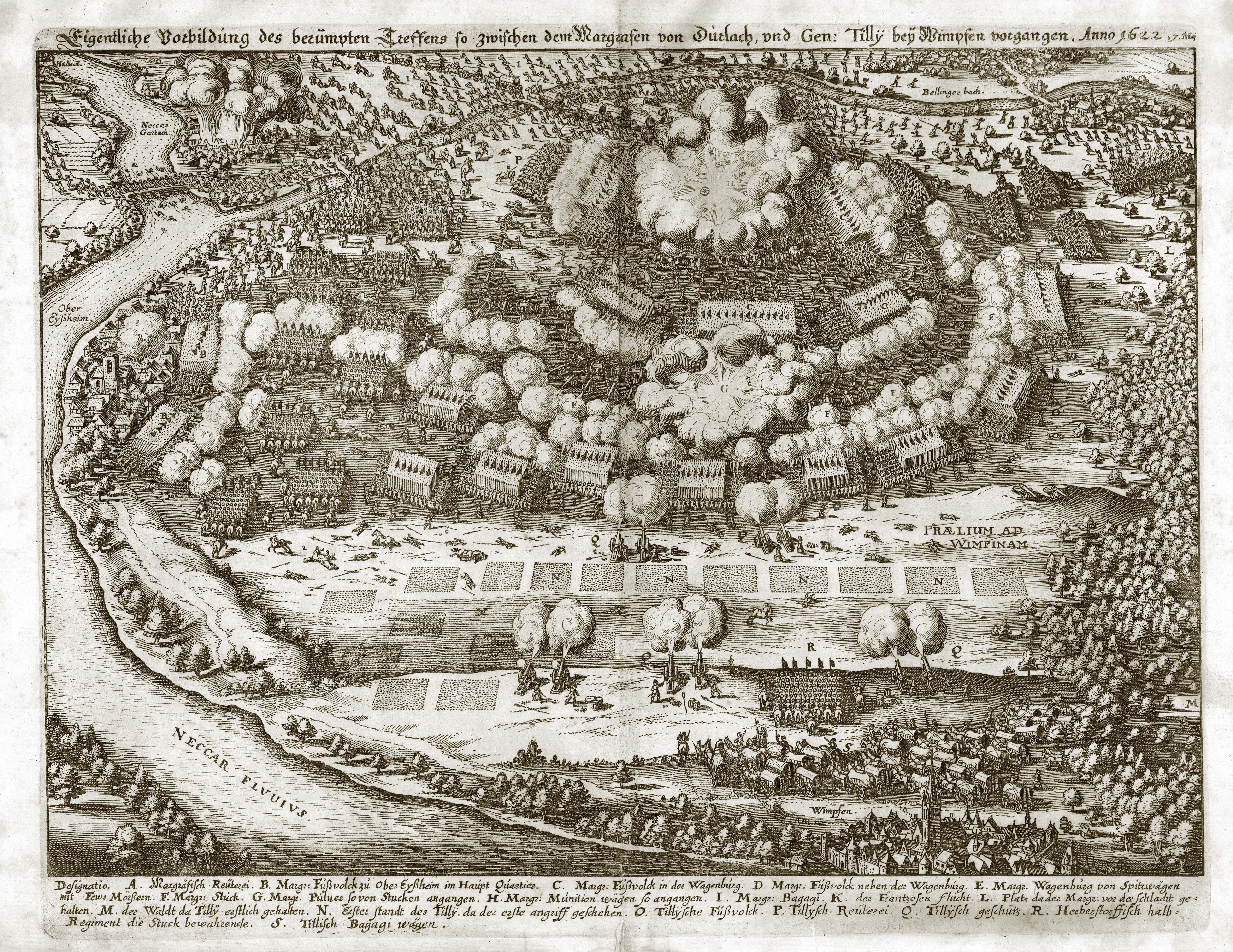
The Battle of Wimpfen. Etching from Merian's Theatrum Europaeum,
vol. 1, 3rd ed. 1662, after p. 692

Battle of Wimpfen

The Battle of Wimpfen was part of the Bohemian Revolt in the early portion of the Thirty Years' War.  It occurred on May 6, 1622 near Wimpfen. The forces of the Holy Roman Empire and the Catholic League under Marshal Tilly and Gonzalo de Córdoba defeated the Protestant forces of General Ernst von Mansfeld and GeorgFriedrich, Margrave of Baden-Durlach.
 Friedrich
After the fall of the Bohemian capital of Prague following the Battle of White Mountain on November 8, 1620, Georg Friedrich decided to continue the fight. and oppose Tilly and Cordoba at Wimpfen.

On 27 April, George Frederick declared war on the Habsburgs and combined his forces with those of Mansfeld, so as to fight the Catholic League together. By early May, the soldiers of Christian of Brunswick had arrived to the north of the Neckar River and were prepared to assist the Protestant forces. This came as good news to the combined forces of Mansfeld and Georg Friedrich, who hoped to combine their armies before risking a major battle.

To gain time and to attempt to split the combined Catholic army, Mansfeld crossed the Neckar near Heidelberg while Georg Friedrich marched east up the river to cross at Wimpfen. The plan failed as the troops under Tilly and Córdoba did not split and instead pursued the 14,000 strong army of Georg Friedrich and cut him off near Wimpfen. Outnumbered, Georg Friedrich deployed his troops into a defensive position on a low hill outside of the village. Here the Protestants made an effective stand, rallied by a strong artillery position until a random Spanish countershot exploded the Protestant magazine, costing the Badeners their position. The Catholics assaulted the hill and shattered the Protestant army. Georg Friedrich then fled to Stuttgart with the few remaining men under his command.

Who is the artist of the first painting?

The Wars of Louis XIV blog post identifies the painter as Simon de Vos possibly based on this link or maybe this one. However the web site for the State Hermitage Museum in St. Petersburg identifies the artist as Sebastiaen Vrancx. The Wikipedia article on Sebastiaen Vrancx also identifies him as the artist. It further observes that he was well known for painting battle scenes which would support him as a likely artist. On the other hand, the neither the English nor the Netherlander Wikipedia articles on Simon de Vos mention the Battle of Vimpfen (or Wimpfen) at all.

Also of note is that the entry for the Hermitage contains the following “Acquisition date: Entered the Hermitage in 1933; transferred from the Antikvariat All-Union Association.” The two links that identify Simon de Vos as the artist both list "Source: All-Union Society 'Antiquariat', 1933." Since the Hermitage acquired the painting from the All-Union Society I'm going to assume that the attribution was later changed to Sebastiaen Vrancx and since that is the attribution used by the current holder of the painting, I conclude that Vrancx, not de Vos, is the actual artist.

Tuesday, July 19, 2016

Military March

Being interested in the military, but never having served, I spend some time reading to get a sense of what the military is like - which is even more important when the military I am interested in is from 400 years ago. I like a fair bit of realism in my gaming so when I wanted to know how fast a soldier marched, I did a little research. Fortunately Al Gore invented the Internet...or was that CERN? Or maybe ARPA? In any case, nowadays a little research is easy.

So for anyone who likes realism in their gaming...


Napoleonic Pace Step
(in ft)
ft/min mi/hr


British Light Infantry 140 2.5 350 3.98


Line Infantry 120 2.5 300 3.41


Highland Infantry 112 2.5 280 3.18


Slow March 60 2.5 150 1.70


Quick March: This is an instruction to begin marching at the Quick March speed with the left foot. The standard pace is 120 beats per minute with a 30-inch step, with variations for individual regiments, the pace given by the commander, and the speed of the band's rhythm: British light infantry and rifle regiments, for example, Quick March at 140 beats per minute, a legacy of their original role as highly mobile skirmishers. Highland regiments, which march to bagpipe music, march at 112 paces per minute.

For the US Marine Corps, the interval between ranks and files is both 40 inches. The light infantry version of the march is also used by the Spanish Legion during parades, as well as the Chasseurs of the French Army (Chasseurs alpins inclusive).

Slow March: This is a ceremonial pace, used for funeral marches and when a unit's colours are marched out in front of the troops. It is the iconic march step used in the French Foreign Legion. The standard pace is 60 paces per minute.

In my next post, I use the military marching pace to approximate the time it takes a sentry to go about his rounds in the garden of the Hôtel d'Angoulême.

Wednesday, February 24, 2016

New Resource for Early Modern Sieges


La Hougue, Normandy, August 2012 by David Flintham

I came across this post on the English Civil war site. It's by a Military Historian by the name of David Flintham. He makes the excellent point that warfare in the Early Modern age was often about fortifications - building them, besieging them, defending them, and storming them - rather than about battles in the field. It's an idea I was already familiar with, but sometimes seeing something again triggers other thoughts. Hence my previous post.

I was also happy to see that David Flintham had also created a site on sieges. Predominantly this is for the English Civil War or as he calls it the War of the Three Kingdoms - which in addition to being more geographically correct is just a helluva better name. But it also includes information on some other conflicts and he includes a nice little article on Vauban, the Frenchman who turned fortifications and siege craft into a science and not just an art. There is a line in the 1992 Michael Mann version of Last of the Mohicans that always reminds me of Vauban and Early Modern siegecraft.

Maj. Duncan Heyward: Might I inquire after the situation sir, given that I've seen the French engineering from the ridge above.

Colonel Munro: The situation is that his guns are bigger than mine and he has more of them. We keep our heads down while his troops dig 30 yards of trench a day. When those trenches are 200 yards from the fort and within range, he'll bring in his 15-inch mortars, lob explosive rounds over our walls, and pound us to dust.

The calculation of digging 30 yards of trench a day to reach a distance of 200 yards from the fortifications is typical of Vauban-style sieges: measured, planned, and predictable. Unless the defenders surrender first, once the walls are breached and the attackers storm the town, science and predictability give way to chaos, rapine, and slaughter. The end of a siege could be a grim and bloody affair.

So take a look at David Flintham's site. It's well worth the look.


<< Previous Post |

Tuesday, February 23, 2016

Sieges


Sieges were a major component of Early Modern warfare. Towns and cities in the period were surrounded by defensive fortifications: walls, ditches, and bastions. Building and maintaining those defenses were expensive activities that required significant capital outlay. Defending or breaching those defenses where one of the most common, if not the most common, major military actions in the Early Modern period. These events are depicted in many drawings, sketches, and paintings, commemorated in song, and even make there way into fiction set in the period, e.g. the 1627-1628 Siege of La Rochelle is prominently featured in Dumas' The Three Musketeers and the 1757 Siege of Fort William is a key element in the movie Last of the Mohicans. Similarly games set in this period should, and often do, reflect this historical fact. 

In the original period RPG, "EnGarde!" out of the 60 possible force deployments only 26 are Field Operations. The remaining deployments are all related to fortresses with Siege: 14, Assault: 9, and Defense: 11. So characters will end up involved in Field Operations about 43% of the time while being one side or the other of a fortification occurs 57% of the time.

"Flashing Blades" has an even simpler method for determining the type of military operation (page 26).

Roll. . . . .Situation
1 . . . . . . .Siege
2 . . . . . . ,Battle
3 . . . . . . .Under Siege
4 . . . . . . .Repeated Skirmishes
5 . . , . , , .Attack
6 . . . . . . .Battle

Field Operations are 50% of the results (either Battle or Repeated Skirmishes) while deployments related to fortifications are 50% of the results (either Siege, Under Siege, or Attack). Attack is what is also called storming and this is where grenadier units, in their original meaning of soldier tossing fused explosives, are at a premium and count double in the Flashing Blades army combat calculation.

"Honor+Intrigue" is focused on the actions of characters rather army campaigns and does not include a dice driven system for generating or resolving military campaigns. It does, however, include a system for resolving ship-to-ship actions and battles. And in the section on battles we see an example for the above mentioned Siege of La Rochelle.

Example: In France, the fortified city of La Rochelle is in
rebellion. King Louis’ army is moderately better trained (+1),
and overwhelmingly larger (+4). However, the rebels have an
overwhelmingly advantageous position, being in a fortified city
that can only be attacked from one side (+4 to their Army Rating).
Louis’ men are much better supplied, however (+2). Both sides
have very competent commanders (+2 to each). This leaves King
Louis’ army with an Army Rating of 9 and the rebels with a 6,
giving Louis’ Army a +3 to its rolls. In all likelihood, Louis’
army will win the Siege, unless the rebels get reinforcements from
England to turn the tide. However, the actions of a small band of
Musketeers may be able to hasten victory before that happens.

I supplement my H+I campaign by using the military campaign rules from Flashing Blades. And have used the historical siege of Bergen op Zoom as a major campaign arc. 

In my next post, I'll highlight a new resource I found for sieges in the period.

                                     | Next Post >>