Monday, June 13, 2016

What I'm Reading: Samurai William

Samurai William: The Englishman Who Opened Japan


by Giles Milton

Milton's book starts out in 1611, when the merchants of London's East India Company received a mysterious letter from Japan, written several years previously by a marooned mariner off a Dutch ship, an Englishman named William Adams. Access to Japan by Europeans was very limited, yet Adams had been living in this unknown land for years. He had risen to the highest levels in the ruling shogun's court, taken a Japanese name, and was now offering his services to the English king as adviser and interpreter.

Now instead of some guy named William Adams, you might think the first Englishman to enter Japan was this guy...
...Richard Chamberlain as John Blackthorne. 

But if you though that, you would (a) be wrong and (b) be old enough to remember the 1975 miniseries, Shogun. James Clavell based his book (which was turned into a miniseries) on William Adams.

The book includes a lot of material about exploration in the period and includes material on failed attempts to reach Japan and the East via a northwest passage and even a northeast passage route above Russia. (That was news to me and such an attempt would make a great hook for an Arctic sea voyage. I was also surprised at how ruthlessly violent trade was in the Far East. Massacres of English traders by the Dutch - nominally allied with the English - to attempt to limit the spice trade; and scheming by the Portuguese and the Spanish, and their Jesuit advisors, to keep Protestants out of the East; and Dutch assassins. At times it seems to gonzo to be actual history. 

For RPG players, William Adams's rise from a common London origin, to navigator on a Dutch ship, to friend and advisor to the Shogun of Japan is a great example of true life zero to hero.

The author uses a lot of original writing by the various principles, while that is great from a primary source perspective, it does make the book somewhat scattered in its point of view. But overall, Milton provides an interesting story and useful nuggets of fact about a little known (at least in the West) person, place, and time.

I give it 3 out of 4 stars.

Sunday, June 12, 2016

Random Bird Chart

I like random tables. A lot. And while I am not alone in that, this guy kind of takes the cake.

Just for the heck of it, I ran the numbers to get the probability for any specific bird to be encountered.


50.00% 50.00%   Nothing
10.00%
  Solitary Birds

0.83%   Vale magpie

0.83%   Black-eared Wheatear

0.83%   Atvian magpie

0.83%   Stonethrush

0.83%   Ring Ouzel

0.83%   Atvian Jay

0.83%   Atvian Oriole

0.83%   Spotted Nutcracker

0.83%   Spotted Jay

0.83%   Red-black Shrike

0.83%   Isabell's Shrike

0.83%   Stone Chough
10.00%
  Small Songbirds

1.25%   Atvian Wren

1.25%   Cathadrian Lark

1.25%   Citril Finch

1.25%   West Wall Accentor

1.25%   Shoe-toed Lark

1.25%   Common Starling

1.25%   Elvish Nuthatch

1.25%   Atvian Reed-Warbler
10.00%
  Raptors

1.67%   Short-toed Snake Eagle

1.67%   Bearded Vulture

1.67%   Griffon Vulture

1.67%   Tawny Owl

1.67%   Atvian Sparrowhawk

1.67%   Elvish Owl
10.00%
  Gamebirds

2.50%   Black-bellied Sandgrouse

2.50%   Pin-tailed Sandgrouse

2.50%   Chukar Partridge

2.50%   Hazel Grouse
10.00%
  Strange Birds

2.50%   Atvian Curlew

2.50%   Water Pipit

2.50%   Wallcreeper

2.50%   Cuckoo
100.00% 100.00%   Total

I suspect the odds aren't intended to represent actual frequency in the wild, e.g. encountering an Elvish Owl is twice as likely as encountering either a Jay. or a Nutcracker and the four most likely birds are in fact the "Strange Birds" - which would make them rather common rather than strange. I expect the author wanted to make a ratio of more interesting birds available for the PC who was looking for an animal friend.

A list like this would have been really useful in my old Runequest campaigns. Both for hunters and for Rune-level characters who were looking for birds for familiars. If I were to use this list, I'd add in crows and ravens -scavengers that flock are the most notable (to me) gap in the tables. I don't know that I'll find a use for these in my Honor+Intrigue game, but in any event, I admire the effort and I'll definitely save these tables to my Runequest folder.

Tuesday, June 7, 2016

Why does Europe get cooler stuff?

Masquerouge


Masquerouge is a comic by André Juillard. I've seen some pages from the comics on the web in French and in German, but nothing in English. The hero is a masked vigilante who uses a bow and arrow (like Robin Hood) and a rapier (like Zorror) to fight injustice...of some kind or another. It's tricky when you only have a few pictures and some dialog in a language you don't read. Masquerouge also has a hawk....because hawks are cool. Here's Masquerouge with trademark bow and arrow. 

Here is the cover of issue #2.
This is exactly what I want parts of Paris Below to look like. Even though the Paris catacombs weren't built until the 19th century, the mines that were turned into the catacombs have been around since long before the 17th century. And there are certainly plenty of ossuaries in the walls bordering cemeteries like Les Innocents.

Near as I can tell, the setting is 1624 France - the exact time and place of my H+I campaign. And the pictures are great. Look at the nice detail of the horse pistols and holsters in the top panel of the page.
http://en.2dgalleries.com/planches/2015/344/d/7/juillard-masquerouge-03-le-rendez-vous-de-chantilly-3978.jpg
I think that is Masquerouge's hawk in the bottom panel. In this next picture we see the hawk attacking. Why? Why not!

I want an English version of this comic. Or alternatively some sci-fi or magical way of easily and quickly learning other languages.


Sunday, June 5, 2016

Shapeshifting in Sword and Sorcery Games


This post, Shapeshifting in Sword and Sorcery Games, on Hari Ragat Games makes a nice follow up to my previous posts on the Loup Garou. I like the idea of shamanistic shape shifting and it could make a good alternative to infection or to a direct curse. Check it out.

Here's my previous set of All Hollows Even posts related to lycanthropy:

All Hallows Eve #1: The Wild Man


All Hallows Eve #2: Adventure -- The Werewolf of Blackwood


All Hallows Eve #3: Adventure Seed for a Loup Garou


All Hallows Eve #4: Werewolf Legends


All Hallows Eve #5: The Werewolf Bit You -- Now What?


Saturday, June 4, 2016

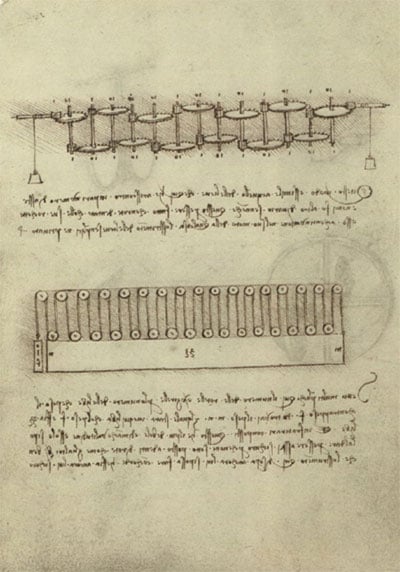
Unusal Item: The Da Vinci Codex

The Da Vinci Codex

"On close inspection of the codex with a mirror they see that it is written in a Italian using mirror writing, so they use a mirror to duplicate the feat. The codex contains plans for Da Vinci's greatest invention, an 'ordinator' or giant mechanical engine designed to calculate and perform all mathematical functions. The inside is planned as a great interlocking series of watch-gears, each representing a small piece of information. The outside bears turning numeral gears and a vast array of buttons and levers."


The first mechanical calculator may have been conceived by Leonardo da Vinci (1452-1519) around 1502. Da Vinci's invention was forgotten for over 300 years. In 1967 scientists working in the National Library of Spain, Madrid stumbled upon two unknown works of Leonardo da Vinci, now know as the "Codex Madrid". One of the works contained notes on a device for calculation. In 1968 IBM hired Doctor Roberto Guatelli, a famous world expert of Leonardo da Vinci, to build a replica.


An early version of today’s complicated calculator, Leonardo’s mechanism maintains a constant ratio  in each of its 13 digit-registering wheels. For each complete revolution of the first handle, the unit wheel is turned slightly to register a new digit ranging from zero to nine. Consistent with the ten to one ratio, the tenth revolution of the first handle causes the unit wheel to complete its first revolution and register zero, which in turn drives the decimal wheel from zero to one. Each additional wheel marking hundreds, thousands, etc., operates on the same ratio. Slight refinements were made on Leonardo’s original sketch to give the viewer a clearer picture of how each of the 13 wheels can be independently operated and yet maintain the ten to one ratio. Leonardo’s sketch shows weights to demonstrate the equability of the machine."

The "lost" Madrid Codex is a McGuffin in the Flashing Blades Adventure: The Man in the Mask. The PCs are sent to obtain the notebook, which contains plans for the calculator, called an "ordinator." I particularly liked Mark Pettigrew's use of a real document for his adventure plot. After reading up a on the Madrid Codex I found Pettigrew's suggested resolution of the scenario wherein the Codex is  tossed in a bonfire a clever "explanation" for the document's real world disappearance. Of course since we now know that the codex was either not destroyed or that there was a copy that ended up in Spain, the apparent destruction, may have been a ruse.

Da Vinci wrote his notebooks in a sort of code using mirror writing. He wrote everything in mirror image (probably by using a mirror). This provided a nice puzzle for the Savvy PC to solve.


"On close inspection of the codex with a mirror they see that it is written in a Italian using mirror writing, so they use a mirror to duplicate the feat. The codex contains plans for Da Vinci's greatest invention, an 'ordinator' or giant mechanical engine designed to calculate and perform all mathematical functions. The inside is planned as a great interlocking series of watch-gears, each representing a small piece of information. The outside bears turning numeral gears and a vast array of buttons and levers."

And there are many other amazing products of Da Vinci's genius to serve as McGuffins for additional adventures.

In Popular Culture
  • The plot of the clockpunk 2011 version of the movie The Three Musketeers uses Da Vinci's notebooks, and several of the inventions therein, as the McGuffin that sets the plot rollling. Someone who wants a gonzo clockpunk should watch this film.
  • The Starz TV series Da Vinci's Demons uses working and often fantastical versions of many of Da Vinci's inventions. The series is a great source for gonzo plots and devices.

Friday, June 3, 2016

It ain't pretty...

...but it's usable.


I was going to do a post on Da Vinci's plans for a calculator, but that will have to wait. In my current campaign (May/June 1624) the players have been investigating the handcarts pushed by some raggedy men that transported some huge rats from the sewers to the granaries around Paris. Their search led them to the basement of Bon Robert's tavern - a seedy little spot north of Les Halles market. I find describing rooms for players to map over Skype is more difficult than I recall it being long ago when we did cave and dungeon exploration in D&D and Runequest. So periodically I give the players a version of what they have explored. Since they may revisit the sewers this weekend, I wanted to post a players version map for their use. So here it is.

It looks a little odd because I snipped bits from my GM's map and left out the areas e.g. behind the iron door, that have not been investigated. The 3D image of the block is from the 1615 Merian map of Paris.

EDIT: Let's try uploading the picture directly.


Download Map

Thursday, June 2, 2016

Introduction of a new PC

In the D&D campaigns of my youth many players and parties made up of the PCs of those players who were available that session were the norm. Gradually my style of play shifted to a smaller group of players who played regularly. This tended to promote two different styles of campaign. The single group of PCs who were closely linked and a troupe style of play where each player had multiple PCs and they selected the PC or PCs who were most fitting for the anticipated activity. 

One expectation of the D&D campaigns was that little rationale was necessary for why a new PC was accompanying the party. Everyone knew that, from an out of game perspective, Dave's PC was there because Dave was there and he needed to play some character to have any fun that night. As the PCs became part of an established group or troupe of associated characters - like the crew of a starship - more explanation was needed in game to justify why Dave's PC was joining an established group. Which is a long introduction to an example of the justification I used to introduce a new PC, Father Signoret, to my Honor+Intrigue campaign. Note that Father Signoret's cousin, Guy de Bourges is one of the campaign's original PCs.


Ad maiorem Dei gloriam!


By the flickering candlelight, the dark clad figure moved precisely over the geometric symbols chalked out on the old basement floor. If not for the sword held lightly in one hand, one might have thought the figure was practicing some new style of ballet. But the dancelike circular movements were part of La Verdadera Destreza – the True Art or as some called it, the Spanish style – whose precepts are based on reason, geometry, and the writings of classical authors such as Aristotle, Euclid, and Plato. A style perfectly suited to a Jesuit-trained scholar of the classics. At least so Father Gaétan Signoret said to those within his order who criticized his fascination with the True Art. But even this momentary break from the focused concentration required to perfectly perform the precise movements, caused an awareness of other sensations that came in a sudden rush: the trickle of sweat down his chest and back despite the cold of the basement, the heaviness in his arms and legs from long exercise, the smell of burning animal fat in the cheap tallow candles that were all he allowed himself for his exercises, and the sound of his deep, but even breathing…Not just my breathing, someone else is in the room with me. He turned quickly, but fluidly, letting blade lead arm, body, legs, and feet. He was not alone. Down the three foot length of steel he saw the startled gaze of his mentor and friend, Denis Petau or Dionysius Petavius, the Latinization of his name that he preferred for teaching and for scholarly debate. Dionysius Petavius was one of the most brilliant scholars in a learned age and a member of the Societas Iesu, the Jesuit Order. 


“Gaétan, Gaétan, always this fascination with the sword. I had hoped to find you reading the works of the ancients or the Scriptural Exercises.” Gaétan smiled somewhat sheepishly. “Well you must set your sword aside for now. The Provincial Father wants to see you. In his office. Now.” Petavius had taught Gaétan theology when he first began his studies back in Bourges. It was Petavius that opened his eyes to the cut and thrust of intellectual debate. If not for his mentor, Gaétan would never have become a Jesuit. Like most of his social class, he would have remained a practically unlettered aficionado of the hunt or the sword. Not that Gaétan didn’t enjoy the hunt or the sword, but those physical activities did not circumscribe a world view which had grown to include Church theology and history as well as the brilliance of ancient thinkers such as Plato, Aristotle, and Euclid and which was enforced with the rigid discipline and self-abnegation central to the life of a Jesuit.


“Of course,” he said as he bowed his head in acknowledgement, then he gestured with his rapier. “I suppose I had better leave this until after I have seen the Provincial Father. What is it he wants?”


“The Provincial Father did not see fit to explain his reasons to me, Gaétan. Nor did he expect you would need a reason beyond his summons.”


“Of course Father. I was only curious.”


“Curiosity is a good thing in a scholar, Gaétan. But our curiosity must always be tempered by our obedience.” 


When Gaétan entered the office of the Provincial Father, the first face that he saw was that of Louis Cellot. The Provincial Father was an intelligent, kindly looking man He was a respected scholar of the humanities, a theological writer of some note, a dramatist and poet, and possibly the most powerful member of the Order after Muzio Vitelleschi the Superior General of the Society of Jesus back in Rome itself. Gaétan was surprised to see that the Provincial Father was not alone. There were three other men in the room all of them dressed in clerical garb. One was a man of about forty years of age with the look of a scholar. He spoke French fluently but with a slight accent, possibly German. He introduced the younger man sitting next to him as Jan-Karel. The other was perhaps fifteen years younger. Since he was only in his mid-twenties it was likely that he had not yet taken his final vows. Most members are not as precocious as I am. Jan-Karel spoke with a most pronounced accent, but not one that Gaétan could place. The third man was the most mystifying. He wore a monk’s brown robe but his face was concealed by a black cloth mask. Of the three, he was the only one that the Provincial Father introduced, calling him Père Noir. Gaétan smiled to himself as he thought, No doubt Petavius would say I’m leaping to conclusions, but I suspect that the masked one’s true name is not Father Black. The really odd thing is it seems like even the Provincial Father is deferring to this Père Noir.
 

Initially the man known as Jan-Karel did most of the talking and his conversation was all about one thing, something he called the DaVinci Codex. It was some minutes before Gaétan figured out Jan-Karel meant some sort of book. He certainly talks a lot without really coming near to any sort of point one can actually understand. Apparently the author of this book was someone named DaVinci – Wasn’t he a painter or sculptor or something? And the book itself was thought to pose some great danger. According to Jan-Karel, the book contained the plans for some sort of machine. Maybe a war machine? Neither Jan-Karel nor the older scholar really explained what the machine was for nor what was so dangerous about an old book or the machine it described. I wonder if this would make more sense if they both spoke in Latin?

Perhaps Père Noir sensed that Gaétan was finding the conversation confusing. In any event, he interrupted somewhat abruptly, “Thank you both. Father Signoret is not an engineer nor a geometer, so I think that is enough of the scholarly details for now. I will tell you what you need to know. This book contains a kind of knowledge that the world has not seen for many ages. And like the fruit of the tree of knowledge as described in Genesis, this is knowledge that man is not meant to have. Therefore, we must prevent Adam from eating of this fruit lest all chance of salvation be lost. This knowledge cannot be released into the world and most especially, it cannot be allowed to fall into the hands of the Dutch, English, and German heretics nor of the infidel Turks. Your mission, Father is to ensure that it does not, by bringing the Codex to the Order. As God’s True Soldiers only we can be trusted to keep this knowledge from the wrong hands.” Gaétan noticed that Père Noir spoke quietly and without a trace of accent, but his voice vibrated with passion and intensity. This Père Noir is a very determined man.


“Father Gaétan Signoret, you are directed to find out the current location of the Codex. Do not risk it falling into the wrong hands by being too ambitious or too foolhardy. Better to communicate its location and let us handle its recovery. However, should a safe and certain opportunity present itself, then you will act for the Glory of God. The Codex was last known to be in the possession of your cousin, Guy de Bourges. Father Signoret, do not fail the Order. You act for the Greater Glory of God. Your orders come directly from your own Provincial Father, is that not correct, Provincial Father?”


Louis Cellot, spoke, “Yes. That is correct. Father Signoret, you are ordered to act as Père Noir has directed. Ad maiorem Dei gloriam!”


After evening prayers, Father Signoret pondered this new mission. My cousin is too clever to be easily deceived. I need a plausible reason to spend time with him so that I may observe him and his friends and from that learn something of the whereabouts of this Codex. The Jesuit order allows us to go about the world, perhaps I can suggest an expansion of that rule. Yes. I think that may do the trick.


Therefore on Sunday, Signoret arranged to be at the church in Paris where his cousin Guy usually went to hear the Mass. Afterwards, he told his cousin of his new “vocation” to engage with the world of adventure and practice his skills “for the greater glory of God.” Then he asked Guy’s help in this mission and to introduce him to any adventurous friends that Guy may have.


“I may know one or two.” Guys said with a faint smile. Guy suggested that the two cousins should meet at the Les Deux Chevaux tavern that Thursday night so that Guy could introduce his cousin to his friends.